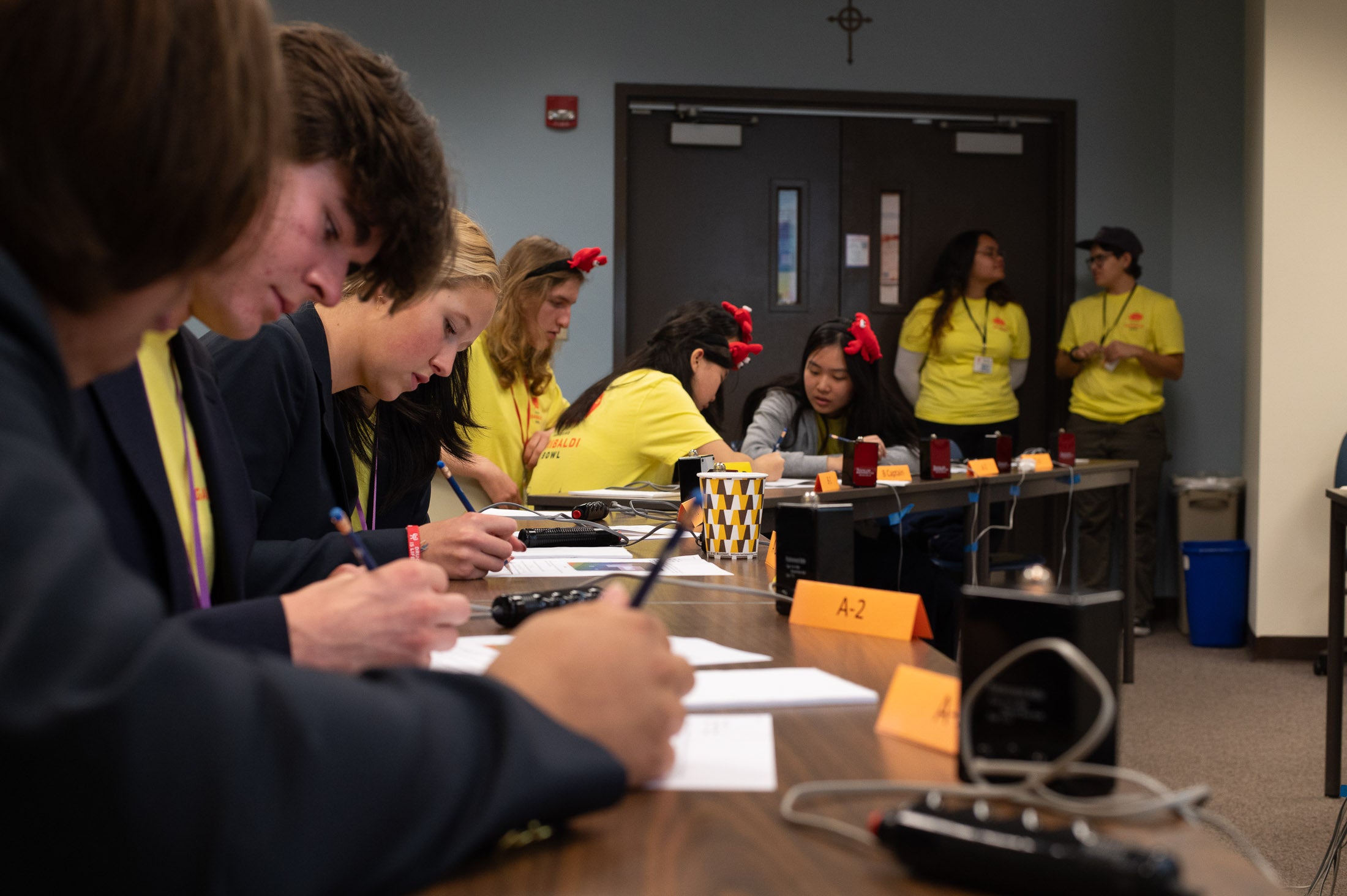
Competition Rules
The National Ocean Sciences Bowl is a timed competition for teams of high school students involving critical thought questions and “rapid memory recall” responses via a “lock-out” responder system. Question topics cover the biology, physics, geology, and chemistry of the oceans, as well as related geography, technology, history, policy, and current events. These rules apply to the Regional and National Finals competitions. The rules may be slighlty adapted for virtual competitions. All event participants must also agree to the Center for Ocean Leadership and National Ocean Sciences Bowl Event Participant Code of Conduct and Anti-Harassment Policy.

To print the rules, select “Print” in your browser window.
- Each competing team consists of at least four student members and a coach. It is recommended that a team include one student alternate. A team of three is NOT eligible to compete. (See Coaching Policy section for more details.)
- To be eligible to compete, a student must be enrolled for the current school year in a public, private, or parochial high school in grades nine, ten, eleven, or twelve at the team’s school, or sanctioned as a home-schooled student.
- Participants must be less than 20 years of age or receive a special waiver from the Consortium for Ocean Leadership to compete.
- Eligible student teams may be formed through a high school, student support organization (e.g. Boys & Girls Clubs of America, Girl Scouts, Boy Scouts), or a home school group. If a student participates through a student support organization, his/her school should NOT have their own team.
- If a student attends a high school with a team, but would prefer to participate with a student support organization team, please contact the National Office with the request.
- Schools considering establishing a NOSB team should select the regional bowl closest, by driving distance, to their home site. If the school location is equidistant between two regional bowl locations, the school may select the preferred bowl location or the bowl location that has availability for new teams. If a regional bowl alternates host sites each year, teams are NOT permitted to switch regional bowls. New teams must select a permanent bowl and attend it for all future competitions. Once an established team has participated in a regional bowl that bowl then becomes the team’s regional bowl for all future competitions. A team’s regional bowl location is permanent and cannot change without approval from the Regional Bowl Coordinator and the National Office.
- Exceptions:
- If a team has been participating in a specific regional bowl, the team is permitted to stay with that bowl location even if another bowl, or new bowl, is closer. However, if a team would prefer to switch to a bowl that is closer to their school location that currently exists or because a new regional bowl location is established, the team MUST contact their current Regional Bowl Coordinator to request a bowl move. The team’s current Regional Bowl Coordinator will contact the NOSB Director at the National Office with the request. The National Office will schedule a meeting with both Regional Bowl Coordinators to review the proposal. The requesting team’s coach, the current Regional Bowl Coordinator and the potential new Regional Bowl Coordinator will receive a letter within three (3) weeks of the initial request that will state the final outcome.
- Schools within the state of Texas are another exception. Due to the size and shape of the state and the locations of the regional competitions, the Regional Bowl Coordinators delineated a diagonal line from just south of the city of Houston up to the lower western corner of the panhandle of Texas. Those schools located below the diagonal line attend the Loggerhead Challenge; those schools located above the diagonal line attend the Dolphin Challenge. Exceptions to this rule can be made at the discretion of the Regional Bowl Coordinators of this region.
If a team switches regional bowls without prior approval from the Regional Bowl Coordinator(s) and the National Office, that team may be disqualified from competing.
- Exceptions:
- Once the competition day has started the composition of the team MUST remain static. Alternate members cannot be “swapped” between “A” and “B” teams from the same school or different schools.
- In the spirit of sportsmanship, the National Office encourages all teams to remain at their regional competitions through the end of the awards ceremony. Regional Bowl Coordinators have the wherewithal to enforce this as a rule, and may disqualify a team from competing at the regional level.
- No school may compete in more than one NOSB regional competition in a given calendar year.
- The winning team from each regional competition is invited to participate at the Finals competition. For the team to be eligible to participate in the Finals, the following rules apply:
- The students on the invited team MUST be the same team of students that won the Regional Ocean Sciences Bowl for that year. No student substitutions can be made.
- All forms in the Winners Packet must be completed and submitted on or before the designated dates after the regional competition.
- All teams must arrive and depart on the designated dates and be in attendance throughout the duration of ALL competition events and activities.
- If an eligible winning regional team (at least 4 team members) is unable to participate in all activities, the second place regional winning team will replace them.
*Any waiver to Rules 1 – 9 must be requested in a timely manner and approved by the NOSB National Office. Regional Bowl Coordinators are encouraged to contact the National Office if they have any questions or issues regarding team eligibility rules.
- Regional Competition Requirements
- Each regional competition site will be managed by a local Regional Bowl Coordinator, and may also have Co-coordinators or Assistant Coordinators to assist with additional responsibilities.
- Each regional competition will occur on one of two dates chosen by the National Office. Regions must pick their preferred date and inform the National Office by September. Regions must also prepare for the rain/snow date announced by the National office. Any other dates require approval from the National Office.
- A regional competition must have a minimum of eight teams from eight different schools to be a sanctioned event.
- All regional bowls must prioritize “A” teams. “B” teams should be used only when no additional “A” teams have registered and there are additional slots for competing teams.
- Regional Bowl Coordinators will choose a competition format that allows for the maximum amount of time for the teams to compete. They will choose a format which may include a variation or modification of the following options:
- Round Robin1 tournament.
- Single Elimination2 tournament.
- Double Elimination3 tournament.
- Round Robin Tournament Formats
- In a Round Robin tournament, teams will be placed in divisions by drawing lots with the number of teams per division as equal as possible. Each team will play every other team in its division.
- In a Round Robin tournament the winner is determined by a tally of wins, ties and losses. Tallies are scored as follows: regardless of the overall score, two points are awarded for a win; one point for a tie; and zero points for a loss. There will be no tie-break questions during the Round Robin matches if followed by single or double-elimination games (see Rules #52-55 regarding tie-breaks).
- The number of divisions in the Round Robin rounds will determine how many teams in each division will advance to double elimination.
- Teams must be informed of competition format and method of breaking ties before the competition begins.
- National Finals Competition Format
- The Finals Competition uses a combination of a Round Robin tournament for the preliminary rounds and a Double Elimination tournament for the final rounds.
- 25 teams are divided into five divisions for the Round Robin tournament.
- The top three teams in each of the five divisions advance to the Double Elimination competition. A single wild card team, based on the best fourth place qualifiers in each division, will be selected based on the tie-breaker/seeding rules (see Rule #53). This brings the number of teams qualifying for the double elimination competition to 16.
- NOTE: Rule #12 is subject to change if fewer than 25 regional teams compete at the Finals Competition. Structure of the Round Robin tournament will be decided by the National Office, as appropriate, given the number of regional teams competing, local venue and timing constraints.
- Teams will be placed into the Double Elimination competition based on the results achieved during the Round Robin competition and scores from the Science Expert Briefing.
- The Science Expert Briefing (SEB) consists of a written report, submitted prior to the Finals Competition, and an oral presentation given to a panel of judges during a bye period of the Round Robin competition.
- The SEB accounts for 25% of a team’s combined SEB and Round Robin score.
- Completion of the SEB is mandatory. Teams that do not complete the SEB will be disqualified from the Finals competition.
- There are five (5) kinds of competition officials required per competition room for each game: Moderator, Science Judge, Rules Judge, Timekeeper, and Scorekeeper.
- Moderator Reads questions and maintains the pace of the game. Science Judge Makes the determination, when needed, in consultation with other officials if appropriate, on whether answers provided by students are acceptable; addresses scientific challenges (see Rules #62-70 on challenges below); resets the buzzer system; and reports the scoring of the Team Challenge Questions to the teams following grading. Rules Judge Maintains the order in the game room, enforces competition rules, responds to challenges to the rules, issues warnings, and passes out Team Challenge Questions and scrap paper. Scorekeeper Tracks and records the teams’ scores throughout the game. Timekeeper Marks the game time with a clock and a stopwatch.
- Additionally, one or two Runners are required for each game. Runner(s) Take the Team Challenge Questions to the Grading and Appeal room and return the Team Challenge Question scored for each team to the Scorekeeper.
- A Grading and Judge’s Appeal room is required. This can also be two separate rooms, if necessary. The following competition officials must be available in the Grading and Judge’s Appeals room(s) during competition rounds: Team Challenge Question Graders Grade the two (2) Team Challenge Questions per round. Chief Science Judge Coordinates and directs the Team Challenge Question Graders and addresses scientific challenges sent to the Grading and Appeal room. Chief Rules Judge Addresses rules challenges sent to the Grading and Appeal room. *Due to specific or unexpected circumstances during their regional competitions, the Regional Bowl Coordinators can exercise flexibility in staffing the above competition officials due to the availability of volunteers. Regional Bowl Coordinators are encouraged to contact the National Office if they have any questions or issues regarding competition officials.
- There are three types of questions in the competition: Toss-up, Bonus, and Team Challenge Questions.
- Toss-up and bonus questions are paired in the competition. A toss-up question is answered by the first competing member of either team who buzzes in and is verbally recognized. The toss-up question must be answered correctly in order for a team to be offered the paired bonus question. Toss-up questions are only in multiple choice format. Bonus questions can be in either multiple-choice or short-answer format. Moderators must provide the correct answers to all toss-up and bonus questions if neither team answers correctly.
- Team Challenge Questions are cooperatively answered, critical thinking questions that require more time and thought than the toss-up and bonus questions and result in a written answer. Each competing team is given the same amount of time to answer these questions, and collaboration among team members is encouraged.
- The head-to-head competition during all regional competitions and the National Finals Competition will be in one of the following two formats:
- 6-minute buzzer segment, two (2) Team Challenge Questions, break (halftime), 6-minute buzzer segment.
- Two (2) Team Challenge Questions, 6-minute buzzer segment, break (halftime), 6-minute buzzer segment. Regional Bowl Coordinators, or National office staff in the case of the National Finals Competition, will choose the format, which will be used consistently throughout that competition, and announce to the teams prior to the competition which format will be used. NOTE: during either format, the second 6-minute buzzer segment will not begin until the Team Challenge Question scores have returned from the grading room during the break and are added to the teams’ scores.
- The scoresheet and an official game clock MUST be visible to all competitors during the buzzer segments of the competition. It is optional to have the game clock visible to the competitors during the Team Challenge Question portion.
- On toss-up questions, the first player on either team to activate the lock-out buzzer system wins the right to answer the question. Team members must be verbally recognized by the Moderator before answering.
- If during a toss-up question, a player 1) answers before being verbally recognized or 2) buzzes in BEFORE the Moderator has identified the format (i.e. multiple choice) of the question, the answer given will be treated as a non-answer or “blurt” and the team will neither gain nor lose points.
- When a team member creates a “blurt” scenario, that team loses the right to answer the question, and the question is offered to the opposing team (See Rule #48 for details on scoring). The Moderator will not indicate whether the answer was right or wrong. If the entire question was read, the opposing team members have the opportunity to buzz in, be verbally recognized, and answer the same toss-up question (See Rule #26). If the entire question was NOT read, the Moderator will re-read the question in its entirety to the opposing team.
- If during a toss-up question, a player buzzes in during the reading of the question, which includes the reading of the last word of the last answer choice (answer Z), the answer given will be treated as an “interrupt.” The Moderator, Science Judge or Rules Judge will announce when a player “interrupts.” Teams will be informed at the beginning of each match which official is making this announcement. If the reading of the question was interrupted, the Moderator will re-read the question in its entirety to the opposing team.
- On short-answer questions (bonus questions only), the first answer given by the team captain is the only one considered by the judges and the answer given must have the same meaning as the answer on the page.
- On multiple-choice questions (all toss-up and some bonus questions), the first answer given is the only one considered by the judges and that answer may be the letter (W, X, Y or Z), the scientific answer or both. If a participant gives both the letter answer and a scientific answer, both parts must be correct.
- Reminder: Players should choose the best answer from the options (W, X, Y or Z) provided.
- With the exception of articles such as “a”, “an,” and “the,” answers to multiple-choice questions must be exactly as those on the written page. If the written answer is singular, the acceptable answer must be singular; similarly, if the written answer is plural, the acceptable answer must be plural. Prefacing the answer with phrases such as “My answer is” is NOT acceptable on a toss-up question. o For example: If the correct answer as written on the page is W. sea urchin, then Acceptable answers are: W; W. sea urchin; W. a sea urchin; W. the sea urchin; a sea urchin; the sea urchin; sea urchin. Examples of unacceptable answers are: My answer is W; urchin; sea urchins; an urchin; X. sea urchin.
- During toss-up questions, consultation among team members is NOT allowed. Consultation is allowed among actively competing team members on bonus questions and Team Challenge Questions. A competition official will verbally note when consultation has occurred.
- If consultation occurs before or after a team member buzzes in to answer a toss-up question, but has NOT been verbally recognized by the Moderator, no points are deducted and the question is offered to the opposing team. If the reading of the question was interrupted, the Moderator will re-read the question in its entirety.
- If consultation occurs after a team member has buzzed in to answer a toss-up question and has been verbally recognized, any answer by that team member is ruled as invalid. If the reading of the question was interrupted, the interrupt penalty applies and the Moderator will re-read the question in its entirety to the opposing team.
- If consultation occurs on the opposing team while the first team buzzing in is verbally recognized and answers the question incorrectly, or forfeits its opportunity to answer, the opposing team is not offered the question. No points are deducted from the opposing team’s score.
- If consultation occurs after the team captain has begun to answer a bonus question, any answer will be ruled as invalid. No points will be awarded or deducted.
- If the answer to a toss-up question is wrong and the question was completely read, the other team is given the opportunity to buzz in to answer the toss-up question, unless time expires before the second team has buzzed in (See Rule #58).
- Once a question has been read in its entirety, it will not be re-read.
- The answer to a bonus question may only come from the team’s captain including when the question is interrupted (by the captain, or any other team member). Moderators will ignore an answer from anyone but the captain on a bonus question.
- On bonus questions, prefacing the answer with “My answer is” or “Our answer is” IS acceptable, but not required.
- When answering a Team Challenge Question, teams will write out their answers on the provided sheet(s) of paper. When time is called the captain will hand in one answer sheet (or multiple-page set). (Note: the answer sheet handed in need not be written by the team captain).
- Answers to the Team Challenge Questions must be written clearly and entered where specified for points to be awarded.
- No notes may be brought to the competition table. Nothing may be written before the game clock starts. Scratch paper will be provided at the beginning of each match and collected at half-time and at the conclusion of the match by the Rules Judge.
- Substitutions may be made only at the break during each match (See Rule #15).
- Prior to each match, the team coaches and alternate team members will introduce themselves to each other and will sit together well away from the competing teams.
- At the end of each match, on the Official Score Sheets provided, the competition officials will record their names and the names of the schools competing, and each team captain will sign off on the scores signifying the scores are accurate and final.
- No cell phones or electronic devices (e.g. smart watches, cameras, tablets, or audio-recording devices) may be used by students, coaches, or audience members once a match is in session, including the 2-minute break. They must remain stowed away in bags or purses. If any electronic device is visible or being used during the match, the person possessing the device will be asked to leave the competition room for the rest of the match. Exceptions to this rule include the Regional Bowl Coordinator(s), National Office staff members, and/or official photographers/videographers employed by the competition host. These individuals will ensure that the use of such electronic devices does not interfere with the competition.
- Coaches and members of the audience may not use writing utensils of any kind once a match is in session, including the 2-minute break. Reading materials, with the exception of the provided competition program, may not be open. If any audience member(s) disregard these rules, any written material will be confiscated and the individual(s) may be issued an official warning or asked to leave the competition room. Exceptions to this rule include the Regional Bowl Coordinator(s) and National Office staff members, as well as the official competition photographer and/or videographer, who may use writing utensils if and when necessary.
- The Finals Competition uses a combination of a Round Robin tournament for the preliminary rounds and a Double Elimination tournament for the final rounds.
- 25 teams are divided into five divisions for the Round Robin tournament.
- The top three teams in each of the five divisions advance to the Double Elimination competition. A single wild card team, based on the best fourth place qualifiers in each division, will be selected based on the tie-breaker/seeding rules (see Rule #53). This brings the number of teams qualifying for the double elimination competition to 16.
- NOTE: Rule #12 is subject to change if fewer than 25 regional teams compete at the Finals Competition. Structure of the Round Robin tournament will be decided by the National Office, as appropriate, given the number of regional teams competing, local venue and timing constraints.
- Teams will be placed into the Double Elimination competition based on the results achieved during the Round Robin competition and scores from the Science Expert Briefing.
- The Science Expert Briefing (SEB) consists of a written report, submitted prior to the Finals Competition, and an oral presentation given to a panel of judges during a bye period of the Round Robin competition. o The SEB accounts for 25% of a team’s combined SEB and Round Robin score.
- Completion of the SEB is mandatory. Teams that do not complete the SEB will be disqualified from the Finals competition.
- Timing of the game begins after the Moderator has identified the format (i.e. multiple choice) of the first toss-up question.
- The first buzzer segment of the game is played until either the time expires (six minutes) or all the designated toss-up questions have been read (10 questions). The team will go directly into the Team Challenge Questions after the end of the first buzzer segment.
- The break occurs while the teams' answer sheets are being graded in the Grading and Judge's Appeal Room and may last longer than two (2) minutes, but must be a minimum of two (2) minutes. However, no one (students or audience members) can leave or enter the room during this break except in the case of an emergency and only with supervision of a competition room official (scorekeeper, timekeeper, etc.). The Moderator will determine if a longer delay is necessary based on the nature of the emergency and will immediately inform Ocean Bowl Central.
- Upon beginning the second buzzer segment, the Moderator will start where the previous buzzer segment ended (e.g. the moderator ended at question #5, so begins the second segment on question #6). The match will continue for six (6) minutes or until a total of 20 question pairs have been presented.
- After reading a toss-up question, five (5) seconds will be allowed for the teams to buzz in before the moderator proceeds to the next toss-up question. Timing of the five (5) seconds begins after the Moderator has completed reading answer Z of the toss-up question.
- If a player buzzes in and blurts, or otherwise answers incorrectly, the question passes to the opposing team, which has five (5) seconds to buzz in before the Moderator moves on to the next toss-up question.
- A participant who has buzzed in on a toss-up question must answer the question promptly after being verbally recognized by the Moderator. After verbally recognizing a participant, the Moderator will allow for a natural pause (up to three seconds) for an answer. If the Moderator determines that stalling occurred, the team loses its opportunity to answer the toss-up question and the question is offered to the opposing team if eligible.
- On bonus questions, the team captain will have 20 seconds after the moderator finishes reading the question to begin to give an answer to the bonus question.
- On a bonus question, the signal "5 SECONDS" will be given by the Timekeeper after 15 seconds of the allowed 20 seconds have expired. In addition, the Timekeeper will indicate the end of the 20-second bonus period by saying "TIME." If the team captain has not begun the response before the Timekeeper calls "TIME," the answer does not count. If the team captain has begun the response, (s)he may complete the answer.
- No stalling may occur. If the Moderator determines that stalling occurred, the team will lose the opportunity to respond to the question.
- On a Team Challenge Question, each team will have at least two (2) minutes to write out their answer on paper. The amount of time given to answer a Team Challenge Question is relative to the difficulty and complexity of the question and will be announced by the Moderator prior to time being started. The Timekeeper will call two warnings: "45 SECONDS" when there are 45 seconds left and "15 SECONDS" when there are 15 seconds remaining. When time has elapsed, the Timekeeper will call "TIME, PENCILS DOWN" and all writing must then cease. The team captain will hand in the answer sheet.
- Results will be announced, and scores recorded, before the beginning of the second 6-minute buzzer segment before the first toss-up question. (Timing for the second 6-minute buzzer segment will begin when the moderator has identified the format (i.e. multiple choice) of the next toss-up question.)
- Toss-up questions are worth four (4) points, and bonus questions are worth six (6) points. Team Challenge Questions are worth 20 points. Partial credit, in whole points only, can be awarded on TCQs.
- If a toss-up question is interrupted, the player was verbally recognized and the answer is correct, the team will receive four (4) points and the opportunity to answer the bonus question. If the answer is incorrect, four (4) points are deducted from the team’s score, and the question is re-read in its entirety to the opposing team. Should that opposing team also interrupt the re-reading of the question, they, too, will be subject to the interrupt scenario rules.
- If a toss-up question results in a blurt (See Rule # 18 for blurt scenarios), this is considered a non-answer and no penalty points will be deducted. (See Rule # 20 for how the Moderator proceeds).
Summary of Scoring:
- When a team member gives an incorrect answer or blurts, the toss-up question is then offered to the opposing team (Rule #41) and all the same scoring rules apply (Rules # 46-48). If the second team also gives an incorrect answer or blurts, the question is no longer in play and the Moderator will read the next toss-up question in sequence.
- If the captain interrupts the reading of the bonus question and gets the answer wrong, no points are awarded or deducted and the Moderator will read the next toss-up question in sequence.
- If the Moderator inadvertently gives an answer to a toss-up or bonus question without giving either team a chance to respond, or gives the answer to a toss-up question or a bonus question before allowing the second team to respond (after an incorrect answer, blurt, or interrupt), the question is removed from the competition and no points are awarded. The Moderator will read the next question in sequence in place of the inadvertently answered question. For example:
- If the Moderator makes an error reading toss-up question #5, the Moderator will throw out the question #5 pair of questions (toss-up and bonus) and read toss-up question #6.
- If the Moderator makes an error reading bonus question #5, the Moderator will throw out bonus question #5 and read bonus question #6. Toss-up question #6 will be removed from play, and the match will continue with the next pair of questions in sequence, pair #7.
- If the Moderator makes an error or inadvertently gives an answer in responding to an incorrect or invalid answer to toss-up question #5 from the first team to buzz in, the Moderator will read toss-up question #6 to the opposing team only and, if that answer is correct, follow with bonus question #6.
Tie-breaks
- In the event that the top teams from each division in the Round Robin portion of the competition are not clearly identifiable, a tie-break procedure in the following order may be used at the regional competitions:
- Head to head won/loss record from the Round Robin games (i.e. if there are only two teams tied the winner of the earlier game they played against each other in the Round Robin will proceed to Double Elimination)
- Fewest losses of each team during the Round Robin games.
- If two (2) teams are still tied, there will be a match between the two teams in which five (5) toss-up questions will be asked in a row. No bonus questions will be used during this segment of the competition. If still tied, another five (5) toss-up questions will be asked until the advancing team is determined. The interrupt penalty of -4 points is in effect.
- If more than two teams are tied, each team, in separate rooms, will be given a series of 10 toss-up questions (no bonus questions will be used during this segment of the competition). The usual five (5) seconds will be allowed for a competitor to buzz in after the question is completely read. The interrupt penalty is not in effect here, but there is also no reason to interrupt since all 10 questions will be read to determine the score and competing teams are in separate rooms. Scoring will be based on the number of questions right minus the number wrong. If two or more teams are still tied, procedure iii or iv, as appropriate, will be used until the advancing teams are determined.
- At the National Finals Competition the tie-break procedure will be used in the following order (Regional Bowl Coordinators may use this procedure at the regional competitions if they so choose):
- Head to head won/loss record from the Round Robin games.
- Fewest losses of each team during the Round Robin games.
- Point differential as calculated by subtracting the total number of points scored against from the total number of points scored, with the greater point total receiving the higher seed.
- Total number of points scored with the greater point total receiving the higher seed.
- A coin toss.
- If only two teams are tied for first in a single division at the end of the Round Robin games, no resolution is necessary as both teams will advance to the double-elimination games.
- If the score is tied (in the double-elimination phase only) at the end of the regulation time period, a series of five toss-up questions will be used to break the tie (alternates may not enter the game at this time – see Rule #32).
The following rules apply if the toss-up question HAS been completely read before time runs out:
- If neither team has buzzed in before time runs out, the game or buzzer segment is over.
- If a player buzzes in before time runs out, the question remains “in play.”
- If, after verbal recognition by the Moderator, the player gives a correct answer, his/her team gets to answer the bonus question and then the game or buzzer segment is over.
- If, after verbal recognition by the Moderator, the player gives the wrong answer, the game or buzzer segment is over.
- If the player blurts out an answer, the other team is given five (5) seconds to buzz in and answer. Should a player on the second team buzz in, be verbally recognized by the Moderator and answers the question correctly, the team will also get the opportunity to answer the bonus question. Then the game or buzzer segment is over. If a player on the second team buzzes in, is verbally recognized, but answers the toss-up question incorrectly, the game or buzzer segment is over.
The following rules apply when the toss-up question has NOT been completely read and time runs out:
- If neither team has buzzed in before time runs out, the game or buzzer segment is over.
- If a player buzzes in before the toss-up question has been completely read, is verbally recognized by the Moderator before answering, and time runs out, the question is still “in play.”
- If the player gives a correct answer, his/her team gets to answer the bonus question and then the game or buzzer segment is over.
- If the player gives the wrong answer, four (4) points are deducted from his/her team’s score, and the question is read in its entirety to the opposing team. If a player on the second team buzzes in, is verbally recognized and answers the toss-up question correctly, the team will also get the bonus question. If a player on the second team buzzes in, is verbally recognized, and answers incorrectly, the game or buzzer segment is over.
- If the player blurts out the answer, the Moderator will re-read the question in its entirety to the opposing team. If a player on the second team buzzes in, is verbally recognized and answers correctly, the team will also get the bonus question. If a player on the second team buzzes in, is verbally recognized, and answers the toss-up question incorrectly, the game or buzzer segment is over.
- There are two types of challenges that team members may make during a game: challenges to the scientific answer, and challenges to the enforcement of the competition rules. The team member requesting the challenge must state up front whether they are requesting a Rules Challenge or a Science Challenge.
- All challenges must come from one of the team members who are actively competing. No one from the audience may initiate, object, or engage in a challenge.
- The team member will raise a hand and verbally request a challenge from the Moderator BEFORE the Moderator has identified the format (i.e. multiple choice or short answer) of the next toss-up or bonus question. A challenge will not be considered unless the team member is first verbally recognized by the Moderator. Challenges regarding the last toss-up or bonus question must occur BEFORE beginning the Team Challenge Question portion of the game (if challenge occurs at the half) OR before the Moderator has announced the end of the match.
- All challenges will initially be decided upon collectively by the officials in the room (including challenges to the rules and/or the science). If the team requesting the challenge disagrees with the ruling of the room officials, the team member who requested the challenge can challenge a second and final time.
- For challenges that can NOT be resolved in the room because the officials do not feel they have the expertise or because students have challenged the officials ruling for the second time, the challenge must go out of the competition room to the Grading and Judges’ Appeal Room. All decisions made in the Grading and Judges’ Appeal Room are FINAL. NO EXCEPTIONS.
- If the results of a challenge determine that an answer that had been ruled incorrect is actually correct, the appropriate team will be awarded the correct number of points.
- Should a challenge be requested during a competition, the timekeeper will stop the game clock at the initial request for a challenge OR when the question is no longer in play, and will not re-start the game clock until the question or challenge is resolved. Once resolved, the match will continue from that point. Should the competition officials decide that time was lost due to the interruption, they will add the appropriate amount of time back on the game clock.
- If the game clock has NOT been stopped by one of the competition officials during a challenge or other discussion, players can respectfully ask the officials to stop the game clock. If a team member feels a rule regarding the game clock has not been enforced, the team member should request a Rules Challenge.
- Because Team Challenge Questions are graded in the Grading and Judges’ Appeal room, there are NO challenges allowed to the final number of points awarded.
- If a competition official determines that the behavior and/or actions of an individual, team or audience member(s) is disrespectful or causes significant distraction from the proceedings, the officials have the authority to issue a warning to the offending individuals or teams to restore order and fairness to the competition.
- Any competition official that feels a situation demands a warning during a match will request the game clock to be stopped. The officials will then collectively make a decision on whether to issue a warning. Warnings may be issued to individual players, an entire team competing, or to members of the audience (including coaches).
- The Rules Judge will issue all official verbal warnings and will provide a reason for any warning.
- The warning(s) for both players and audience members will be noted on the Official Score Sheets and tallied throughout the entire competition.
- If a player or team receives two (2) official warnings during any point at the competition event (including free time during the Finals Competition weekend), that player or team is disqualified from competing and is only permitted to respectfully observe the competition from the audience. If a team is disqualified, the Regional Coordinator will be responsible for determining team seeding for the remainder of the competition. At the Finals Competition, the Chief Scorer or member(s) of the National Office staff will determine team seeding.
- If an audience member receives two (2) official warnings they will not be permitted to observe or participate in the competition activities for the remainder of the event.
- If the team with a disqualified player advances to Nationals, the disqualified player is NOT eligible to compete at the National level.
- ALL team correspondence MUST be done by the coach; any inquiries directly from students on a team will not be addressed. Coaches must direct any regional competition questions to their Regional Bowl Coordinator(s). Correspondence about national level issues, except for attendance details regarding the national Finals competition, should still be directed to the appropriate Regional Bowl Coordinator(s), who in turn will contact the national office staff, if necessary*. All Finals correspondence will be handled by the national office staff once the regional competitions have taken place and the teams competing at Finals are known.*Please note: in some cases, such as when a new regional competition host is needed or issues arise with a current regional competition host, coaches will be asked to communicate solely with the national office. Should this occur, the national office staff will contact the coaches directly, as well as post instructions on the regional competition map page of its website.
Coach responsibilities include:
- Preparation and supervision of team members.
- Timely completion of applications and forms.
- Maintenance of high ethical and sportsmanship standards, both in preparation and in competition.
- Compliance with policies of the regional competition/National Ocean Sciences Bowl, and the sponsoring school system or education/science program.
- Once competition registration has closed, changes in designated coach can be made only with the prior approval of the Regional Bowl Coordinator. Any substitute coaches will be expected to meet the same eligibility criteria and carry out the same responsibilities as the original coach. Teams arriving on the day of competition without their designated coach will not be allowed to compete.
- Faculty, staff, and students from the institutions sponsoring a Regional Bowl or Finals Competition are NOT eligible to serve as coaches, but may serve as scientific advisors to teams under the following circumstances:
- Scientific advisors who work with individual teams can have no contact whatsoever with question development and review, with game preparation, or practice sessions for competition officials.
- Scientific advisors are expected to demonstrate the highest ethical standards. Should they inadvertently be exposed to “insider” information of any kind (e.g. overheard discussion of questions, conversations about rules, or comments from competition officials about their perspective on policies and rulings), they are expected to withdraw as team scientific advisors.
- Scientific advisors may not represent the team in communications with competition officials.
- Scientific advisors are not eligible for any awards.
- Any exceptions to the above coaching policies must be approved in advance by the Regional Bowl Coordinator or the NOSB national office. Failure to adhere to policy may result in immediate disqualification of the team from competition.
- A round-robin tournament, or all-play-all tournament, is a type of group tournament in which each team plays every other team or team within their division an equal number of times.
- In a single elimination tournament or a sudden death tournament, the team is immediately eliminated after losing to a single opponent. A full schedule of pairings (brackets) is established before the competition starts and each successive round halves the number of competitors remaining.
- In a double-elimination tournament a team ceases to be eligible to win the tournament’s championship upon losing two games or matches. A double-elimination tournament is broken into two sets of brackets, the Winners (W) Bracket and Losers (L) Bracket. After the first round, the winners proceed into the W Bracket and the losers proceed into the L Bracket. The W Bracket is conducted in the same manner as a single-elimination tournament, except that the losers of each round “drop down” into the L Bracket.